Animal Friends OS / Features / Boarding Medication Tracking
Feeding and medication log
Dog boarding medication tracking software for the kennel floor
Animal Friends OS gives every boarding stay a care plan: each meal and each medication, with its amount, its shift or exact time, and the days it applies. Staff work from a live care board that shows what is still due for every dog in the building, tap Done as each item is given, and the system keeps who marked it. If a feeding or medication is still unmarked after its cutoff, an alert goes up, and a medication is treated as more urgent than a meal. You can also print a medication round sheet with a place to initial each dose. It is record-keeping for your team. It is not veterinary advice and it is not a medical device.
14-day free trial. No contract.
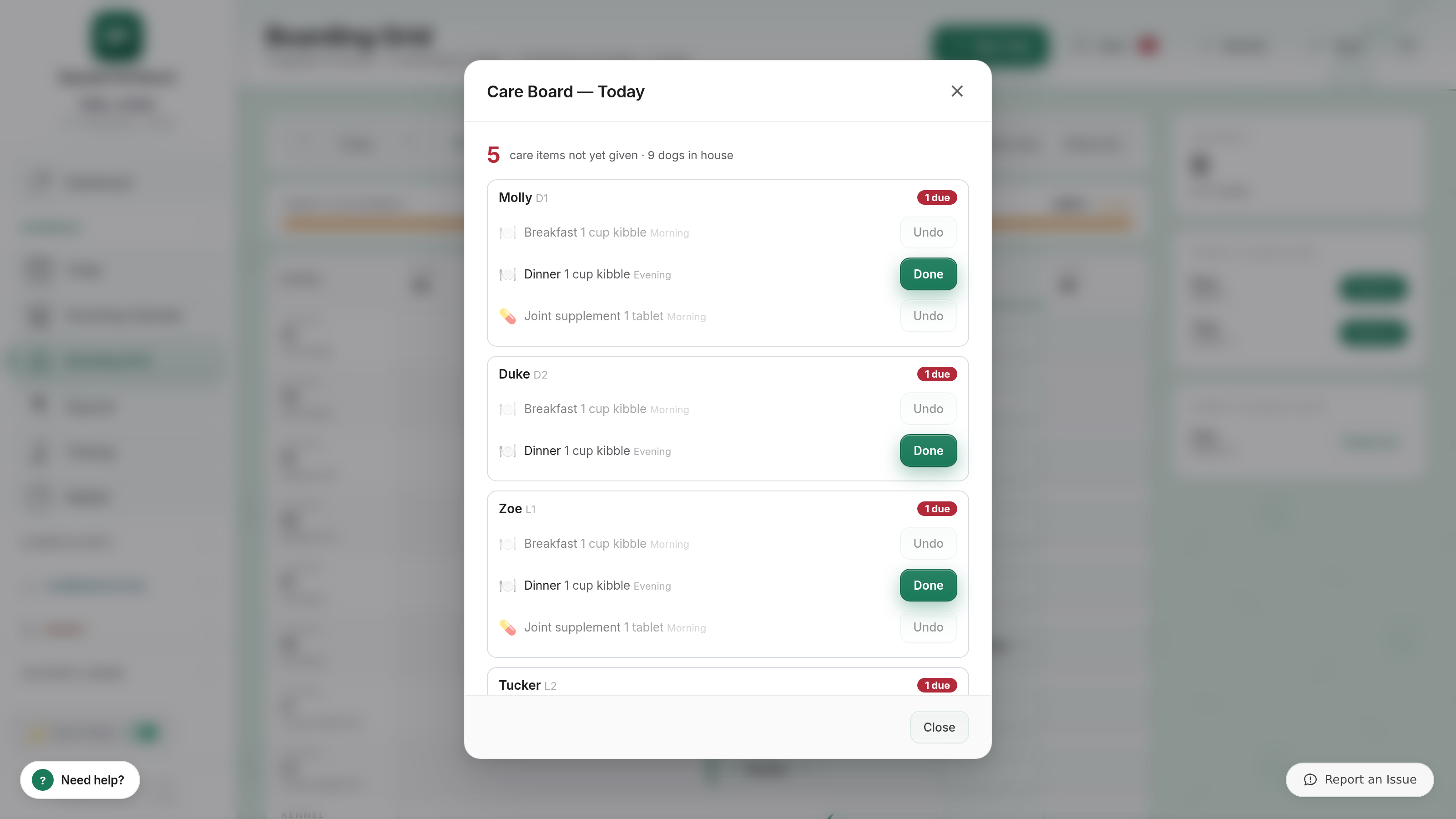
The care board in a demo account: every dog in house, every item due today, one tap to mark it done.
How it works
From the booking to the last dose of the night
- 1
Build the care plan
Each stay gets feeding and medication lines: a label, an amount, Morning, Midday or Evening (or a set clock time), daily or chosen weekdays, and a note. New stays are pre-filled from your feeding template, so staff add just what is specific to the dog.
- 2
Print what staff carry
Run cards hang on the door. The medication round sheet lists every dog due a dose on a shift, with the run, the instruction and an initials line for each dose.
- 3
Work the care board
The care board lists today’s due items for every dog in house, grouped by run. Tap Done as each item is given. Tapped by mistake? Undo puts it back to waiting.
- 4
Watch the cutoffs
If an item is still unmarked after its cutoff, an alert is raised. Medication alerts rank above feeding alerts, and an unresolved one escalates to the owner and managers after an hour.
- 5
Keep the record
Every item records who marked it. Quick logs add how much a dog ate, whether a medication was given, refused or skipped, plus bathroom and outside time, in a timeline for the stay.
What you get
What the feeding and medication tools actually do
| Feature | What it does | Why it matters |
|---|---|---|
| Care plan per stay | Feeding, medication, activity or other items with an amount, a shift or exact time, chosen weekdays and notes. | Instructions live on the stay, not on a whiteboard or a sticky note. |
| Feeding template | Your twice, three times or custom daily feeding times pre-fill each new stay once, at booking. | Breakfast and dinner appear on the board without retyping for every dog. |
| Care board | Today’s due items for every dog in house, by run, with a count of what is outstanding and Done and Undo buttons. | A shift lead sees what is left in the building on a single screen. |
| Medication round sheet | A printable sheet by Morning, Midday, Evening or all shifts, twelve dogs to a page, with an initials line for each dose. | The tech on the round carries paper if the room has no tablet. |
| Overdue alert | Checks the schedule, not just the taps. Cutoffs default to 11:00, 14:00 and 20:00 and are adjustable; items with a set time get a grace period. | The dose nobody touched has no tap to look at. The alert watches for exactly that. |
| Quick care logs | Meal eaten (all, some, none, refused), medication given, not given, refused or skipped, bathroom, outside time and custom log types. | When an owner asks how Hazel ate on Tuesday, the answer is in the timeline. |
| Run cards | Feeding, medications, vet, emergency contact, allergy and behavior flags on one card per dog. | The door sheet and the screen draw on the same data. |
A whiteboard versus a care plan
On a whiteboard or paper chart
- Instructions are rewritten at every check-in, and each rewrite is a chance to copy a dose wrong.
- Nothing flags the dose that nobody touched.
- Who gave it, and when, lives in someone’s initials or memory.
- Owners hear “she ate fine” with nothing behind it.
In Animal Friends OS
- The plan is entered once and appears on the board, the run card and the round sheet.
- An alert fires from the schedule when an item is still unmarked after its cutoff.
- Each item records who marked it and, for done items, when.
- Meal and medication logs sit in a timeline you can read back.
Why a boarding medication log needs more than a checklist
Boarding floors run on shift changes. The person who took the intake at noon is rarely the person giving the evening pill, so whatever the intake learned has to survive a handoff. A care plan attached to the stay is that handoff: the same lines are in front of whoever opens the board, whether that is the opener, the closer or the owner checking in on a holiday.
Most of the trouble in a kennel comes from small gaps, a pill that was given twice because two people each thought it was theirs, or not at all because both assumed the other had done it. A shared board with one Done button per item closes the double-dose gap. The alert closes the missed-dose gap.
The alert that watches what nobody touched
It would be easy to build an alert that looks at just the items someone has already tapped. That misses the case that matters most, because the item nobody touched has no record at all. Animal Friends OS drives its overdue alert from the care plan, then checks each due item against what has been marked. If the item is not marked done or skipped by its cutoff, it shows up.
Cutoffs sit at the end of a shift on purpose, so the alert does not cry wolf at 9:01 because the morning round usually finishes at nine. They default to 11:00 for morning, 14:00 for midday and 20:00 for evening, and you can move each one. An item with its own clock time gets a grace period after that time instead. Undo counts as not handled, because someone deliberately set it back to waiting.
- Medication alerts are raised as critical and feeding alerts as warnings.
- An alert still open after an hour escalates to owners and managers.
- It clears as soon as the item is marked done or skipped on the care board.
- The alert text tells staff to confirm with the handler before assuming a medication was given.
Feeding charts, from template to door
In Boarding Setup you pick how many times a day dogs are fed and the clock time for each meal. Each new stay is seeded with those feeding lines once, when the stay is created, and families booked together get the same seeding for every dog. Changing the template later applies to future stays, which keeps a dog already in the building from having its chart rewritten under your staff.
Per-dog specifics go on the stay: the amount, the food, a note about wetting the kibble or splitting a portion. The same lines print on the dog’s run card, which also carries the vet, the emergency contact and any allergy or behavior flags, so the door sheet and the screen never disagree.
Running a medication round from the printed sheet
The round sheet is built for the tech who walks the building with a clipboard. Pick a date and a shift and it lists every dog with a medication due, with the run, the dog and owner surname, the breed, each medication line with its time and any note, a comments line, and a line to initial. A star marks a dog who is booked but not yet checked in, and a hash marks a dog leaving that day.
If a shop types medications into the pet record as free text instead of building structured lines, the sheet falls back to that text, split one instruction to a line. Dogs with structured medication lines for the morning alone do not show up on the evening sheet. When a sheet is full it runs to a second page, and each page says which page of how many it is.
What “recorded” means, and what it does not
When a staff member taps Done, Animal Friends OS records that this person marked this item for this dog on this day, and for a done item it records the time. That is a useful record of who said what happened. It is not proof that the correct dose was given, and the product does not check amounts, drug names or interactions. Amounts and instructions are text your team enters, taken from the owner and the vet.
Your team remains responsible for medication decisions, and an owner’s vet remains the authority on what a dog should receive. The tools are there so that what was agreed at intake is visible to everyone, and so that a gap shows up while there is still time to close it.
Who it is for
Who this fits
Boarding kennels
Dogs arriving with a pill pocket full of instructions and staff who rotate through the floor each day.
Pet resorts and hotels
Suites with premium guests, daily supplements and owners who expect a clear account of the stay.
Multi-dog families
Each dog gets its own stay, board and card, so one dog’s medication never ends up on a sibling’s line.
Small teams with one lead tech
A single screen of what is still due, so the lead is not holding the whole schedule in their head.
Honest limits
What this does not do
The full list of what is and is not built lives on the facts page.
Questions operators ask
How should a kennel log feeding and medication?
Enter the plan once on the stay, work from one shared board, and record each item as it is given. Animal Friends OS does this with a per-stay care plan, a live care board and a printable round sheet, so the instructions, the doing and the record all come from the same place. Your own protocols still decide who gives what.
Does it track medication doses and times?
It tracks the instruction your team entered, including an amount and a shift or exact time, and records who marked the item done and when. It does not verify the dose itself or calculate anything.
What happens if a medication is not marked done?
An alert is raised once the item’s cutoff passes. Medication alerts are critical and feeding alerts are warnings, and an alert still open after an hour escalates to owners and managers. The cutoffs are adjustable.
Can staff print a medication sheet to carry on rounds?
Yes. The medication round sheet prints for Morning, Midday, Evening or all shifts, with an initials line for each dose. It marks dogs not yet checked in and dogs leaving that day, and it runs to extra pages when the building is full.
Is the feeding schedule set up for each dog by hand?
Your feeding template pre-fills each new stay once, at booking, with your twice, three times or custom daily times. Staff then add the amount, the food and any notes for that dog. Changing the template later applies to future stays.
Can owners see whether their dog ate?
Staff can log each meal as eaten all, some, none or refused, with a note, and the entries sit in the stay’s timeline. How you share that with owners is up to you, for example in a report card sent by text.
Does it check for drug interactions or allergies?
No. It does not hold a drug database. Allergy and behavior flags you enter on the pet appear on the run card so staff see them, but the software does not evaluate them.
Is this a medical record system?
No. It is a kennel operations tool that keeps a record of planned and delivered care for boarding stays. It is not a medical device and does not give veterinary advice.
Keep reading
Related pages
Put the whole schedule on one board
Start a free trial, add a stay, and see the care plan, the board and the round sheet with your own dogs.